Address
304 North Cardinal St.
Dorchester Center, MA 02124
Work Hours
Monday to Friday: 7AM - 7PM
Weekend: 10AM - 5PM
Address
304 North Cardinal St.
Dorchester Center, MA 02124
Work Hours
Monday to Friday: 7AM - 7PM
Weekend: 10AM - 5PM


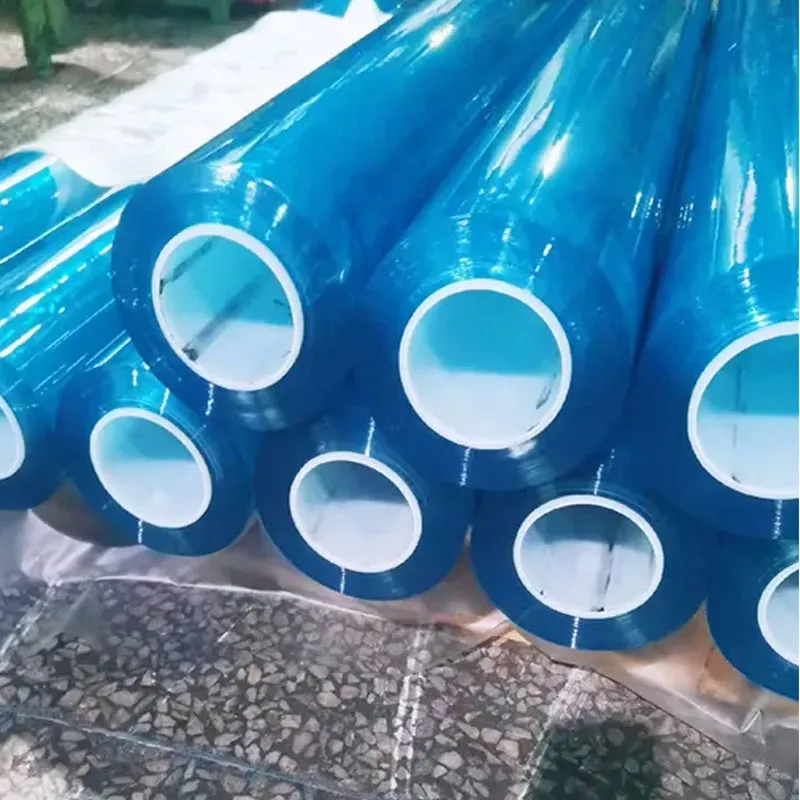
PVC film that shrinks, wrinkles, or cups after production or installation is a common headache for manufacturers, converters, and end users. Dimensional instability reduces yield, causes application problems, and harms brand reputation. This guide explains the main causes of PVC film instability, practical solutions to correct problems, and prevention tips you can apply on production lines, in storage, and during installation.
Differences in PVC resin grade, molecular weight distribution, and the type/amount of plasticizers, stabilizers, and fillers change how the film relaxes after processing. Over-plasticized films tend to be softer and may experience higher post-production shrinkage, while low-plasticizer formulations can become brittle and crack during elongation.
Uneven roll temperatures, inconsistent nip pressure, and rapid cooling create internal stresses. Films cooled too quickly on one side or passed through rollers with variable surface temperatures can develop residual stress that later releases as dimensional change.
Moisture uptake during storage or in converting processes (printing, laminating) can plasticize the surface or cause localized expansion. Conversely, extremely dry environments may cause contraction on one side of the film, resulting in curling or edge warpage.
Calendered and extruded films can have different chain orientation in the machine direction (MD) versus the transverse direction (TD). If orientation is unequal, the film will contract differently along the two axes when stresses are released.
Applying adhesives, inks, or laminates with high solvent content or mismatched thermal expansion can induce stress or soften the surface, causing localized shrinkage or edge lifting once the coating cures.
Tight winding, uneven core tension, or stacking heavy rolls in hot or humid conditions can deform rolls and create permanent set in the film. Improper unrolling or re-rolling before conversion multiplies these stresses.
If instability appears after production, consider controlled annealing: hold the film at a slightly elevated temperature below softening point (e.g., 40–60°C depending on formulation) in a flat, tension-free state to allow stress relaxation. Use caution to avoid overheating or distorting printed surfaces.
Balance calender roll temperatures, slow down cooling rate where possible, and ensure consistent nip pressure across the web. Reducing line-speed spikes and stabilizing melt temperatures helps minimize residual stress.
For minor shrinkage, lamination with a stable backing or use of a pressure-sensitive adhesive can flatten the film. For printed or coated films, choose low-solvent or UV-curable systems that minimize swelling and stress.
Implement MD/TD shrinkage tests (e.g., oven aging at standardized temperature for a set time) and monitor roll tension traces. Early detection lets you quarantine problematic lots before shipping.
| Symptom | Likely Cause | Quick Fix |
|---|---|---|
| Edge curl after printing | Ink solvent swell / uneven coating | Switch to low-solvent or UV inks; controlled drying |
| Uniform shrinkage across roll | Incorrect plasticizer level or rapid cooling | Adjust formulation; anneal to relax stress |
| One-side cupping | Temperature gradient during cooling | Uniformize roll/roller temperatures |

Work with your resin and additive suppliers to specify consistent plasticizer and stabilizer packages. Target balanced plasticization and avoid excessive low-molecular-weight plasticizers that migrate and change film dimensions over time.
Standardize calender settings, nip pressures, and roll temperature profiles. Document machine setup for each SKU so operators can reproduce stable conditions.
Store rolls horizontally on suitable racks, avoid stacking more than recommended weight, and keep humidity and temperature stable.
Wrap individual rolls with dust-proof PE film or kraft paper and label with batch/processing data to speed traceability.
Provide clear handling instructions: acclimatize rolls to the converting environment for 24–48 hours, avoid re-tensioning rolls tightly, and test a sample before large-scale application. For installers in hot climates, advise slightly longer relaxation times to prevent late shrinkage.
Adopt routine MD/TD shrinkage testing, maintain production logs, and use statistical process control to detect drift. When problems appear, batch traceability helps identify whether issues are raw-material, process, or handling related.
If instability persists despite tuning process and handling, consult your film supplier or a materials engineer for formulation tuning, annealing protocols, or lamination strategies. For manufacturing partners, Pulivk (https://pvcfilmtec.com/) offers integrated calendering, printing, and split-packaging services with strict QC and expertise in stable PVC film production.
Dimensional stability is the product of consistent raw materials, disciplined processing, careful handling, and smart specification. Implementing targeted QC tests and following the practical fixes here will reduce waste, improve customer satisfaction, and ensure your PVC film performs as expected.