Address
304 North Cardinal St.
Dorchester Center, MA 02124
Work Hours
Monday to Friday: 7AM - 7PM
Weekend: 10AM - 5PM
Address
304 North Cardinal St.
Dorchester Center, MA 02124
Work Hours
Monday to Friday: 7AM - 7PM
Weekend: 10AM - 5PM


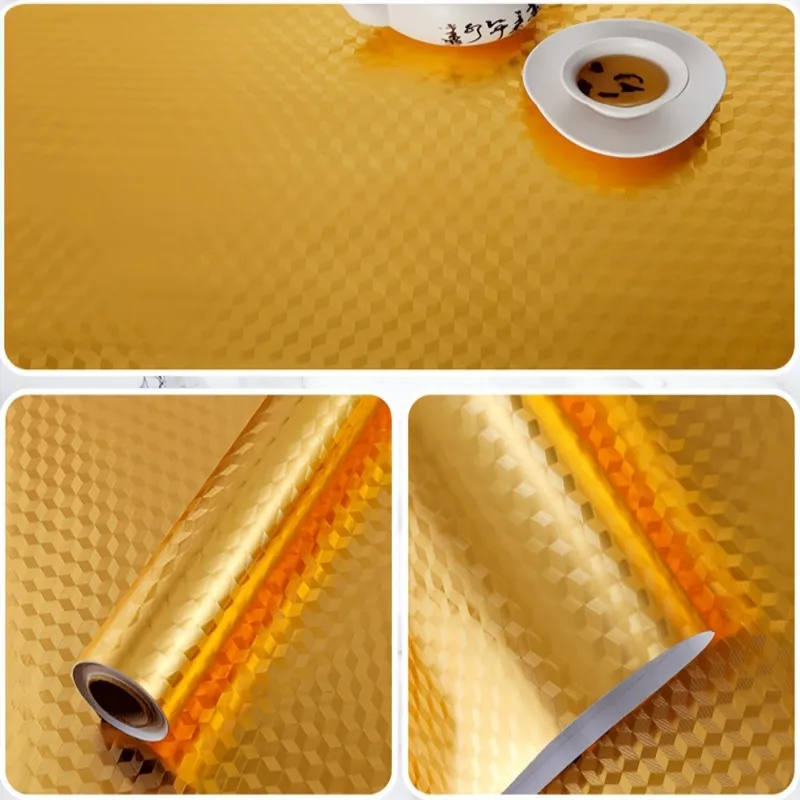
PVC film density is one of those “quiet” specs that strongly influences real-world performance—how a roll feels, how it lays flat, how it prints, how it bonds, and even how much material you truly receive per square meter. Whether you are sourcing decorative films for furniture panels, floor protection films for construction sites, or functional industrial films, understanding density helps you compare products fairly and predict outcomes more accurately.
Key idea:
Density is not the same as thickness. Two PVC films can have the same thickness but different density—and therefore different weight, stiffness, and sometimes different durability.
Density describes how much mass is packed into a given volume of material. For PVC film, it is commonly expressed as g/cm³ (grams per cubic centimeter) or kg/m³.
In purchasing and production, density connects three important parameters:
thickness (µm or mm), area (m²), and weight (g or kg).
★ Practical formula (for quick checks):
Mass = Density × Volume
For sheet film: Mass = Density × (Area × Thickness)
“PVC film” can mean very different formulations. Decorative and calendered films are often flexible (plasticized) PVC, while some packaging or technical films may be closer to rigid (unplasticized) PVC.
Density varies with additives, fillers, and processing.
These ranges are not absolute “pass/fail” rules. A decorative film designed for embossing, softness, or acoustic damping may deliberately use a formulation that shifts density. The right target depends on your application: furniture wrapping, skirting, wall panels, flooring, protective layers, or cleanroom packaging.
Density affects more than the number on a datasheet. It influences how the film behaves across processing and end-use.
For the same thickness, higher density means more weight per square meter. If you buy by weight, density affects how many square meters you get per ton.
If you buy by roll length, density affects roll weight and shipping cost.
Density correlates with formulation choices that impact stiffness, drape, and cutting behavior. This matters for calendering stability, slitting, rewinding, lamination, and thermoforming.
Density alone does not “guarantee” strength or durability, but it can hint at filler level and plasticizer content—both of which influence wear resistance, emboss retention, dimensional stability, and surface feel.
The best method depends on your equipment and accuracy requirements. Below are three widely used approaches, from lab-grade to production-floor friendly.
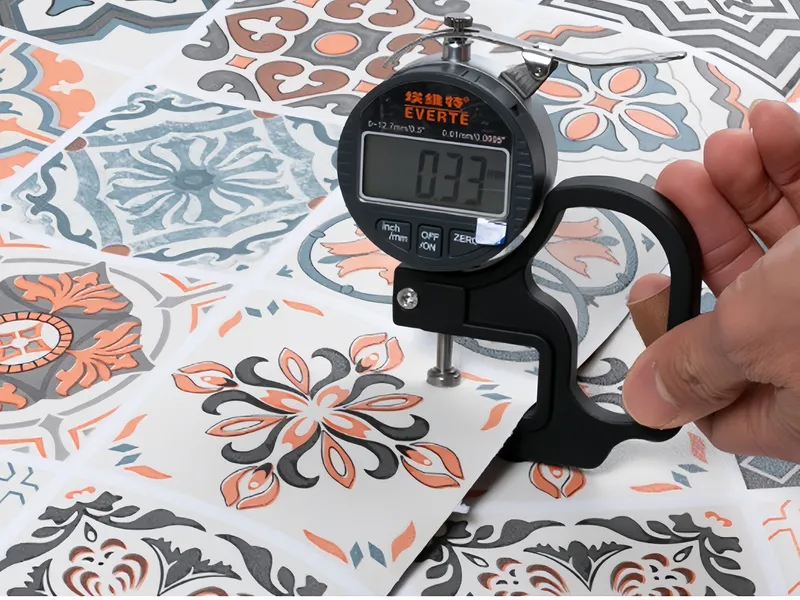
This method is ideal when you have a reliable thickness gauge and can cut a clean sample.
It works well for calendered decorative PVC and many multi-purpose films.
Tip:
If the film is embossed (wood grain, stone texture, 3D patterns), thickness readings can vary widely. Measure more points and avoid peaks/valleys bias.
For high-texture products like 3D silk texture film, agree with your supplier whether thickness is defined by average thickness or base thickness.
Archimedes’ principle can provide accurate density if you can prevent water absorption and remove trapped air. For thin flexible film, it’s often easier to fold/stack multiple layers into a compact shape (without air pockets) or test a thicker plaque from the same formulation.
Caution:
Textured surfaces, micro-voids, and trapped bubbles can skew displacement results. If you use this method, document sample prep carefully so results are repeatable.
For R&D and quality audits, density gradient columns or digital density meters can improve repeatability. This is useful when you need to detect small formulation shifts—such as changes in filler, plasticizer, or stabilizer packages.
PVC film density is driven by both chemistry and structure. Below are the most common factors that cause density changes between suppliers, product families, or even batches.
Plasticizers increase flexibility and processability. Depending on the plasticizer type and loading, density can shift up or down.
In practical terms, a softer “rubbery” feel often signals higher plasticizer content, but you should confirm with spec sheets and compliance requirements.
Mineral fillers frequently increase density and can impact opacity, stiffness, emboss definition, and cost structure.
If two films have the same thickness but one is significantly heavier, higher filler loading may be one reason.
Colored and printed films add mass. For multilayer structures (base film + print + clear topcoat), the “overall density” can differ from the base compound.
For example, decorative products such as wood grain film may include printing and protective layers that influence weight-per-area.
Calendering pressure, temperature, and line speed can change film compactness. Micro-voids (tiny trapped air pockets) reduce apparent density.
This is one reason why consistent line control matters for repeatable results—especially in high-volume products like
calendered film.
Anti-static, anti-fog, easy-clean, or oil-proof coatings can add small but measurable mass. If you compare a standard film to a coated version, the density/weight-per-area difference may be expected—not a defect.
Many buyers compare films using thickness alone, but that can hide important differences. A better approach is to consider thickness together with density, or use GSM (grams per square meter) for quick comparisons.
GSM ≈ Density (g/cm³) × Thickness (µm)
This works because 1 µm thickness over 1 m² equals 1 cm³ / 10,000? In practice, teams use a simplified conversion table or calculator to avoid unit mistakes.
If you want, standardize internally on one unit system (e.g., thickness in mm and density in g/cm³) and build a single spreadsheet.
For flooring and heavy-duty protection uses, GSM is often the fastest “reality check” because it correlates directly with consumption and roll weight.
For example, if you are evaluating floor film options, comparing both thickness and GSM helps prevent surprises in coverage per roll.
On a modern PVC film line, density consistency is largely achieved through formulation discipline and process control:
raw material QC, stable mixing, controlled calendering parameters, and batch traceability.
Full-process production (calendering, printing, slitting, and packaging) helps reduce variability because fewer steps are outsourced and fewer unknowns enter the chain.
✔ What to request from a supplier:
density or GSM targets, thickness tolerance, formulation compliance (REACH/RoHS), test method, sampling plan, and batch records.
If your project needs custom performance (anti-static, soft-touch, oil-proof, etc.), confirm whether functional coatings change weight-per-area and roll yield.
There is no single “best” density. The right target depends on what you need the film to do:
wrap smoothly, resist wear, emboss well, bond reliably, or stay dimensionally stable in heat.
Many flexible PVC films fall roughly in the 1.20–1.35 g/cm³ range, but coatings, pigments, and fillers can shift it. Always confirm with the supplier’s test method and product construction.
The heavier roll likely has higher density due to formulation (e.g., more filler) or added layers (printing/topcoat). Measuring GSM is often the fastest way to compare fairly.
No. Higher density can indicate fillers or different formulations and does not automatically mean stronger, more durable, or better-looking film. Match density to your target performance and compliance needs.
Cut a known-area sample, measure average thickness at multiple points, weigh it, then calculate density using mass ÷ (area × thickness). Keep units consistent and record conditions for repeatability.
For many buyers, specifying thickness + GSM is more actionable than density alone, especially for yield and logistics. Density is still useful for formulation control and auditing.