Address
304 North Cardinal St.
Dorchester Center, MA 02124
Work Hours
Monday to Friday: 7AM - 7PM
Weekend: 10AM - 5PM
Address
304 North Cardinal St.
Dorchester Center, MA 02124
Work Hours
Monday to Friday: 7AM - 7PM
Weekend: 10AM - 5PM


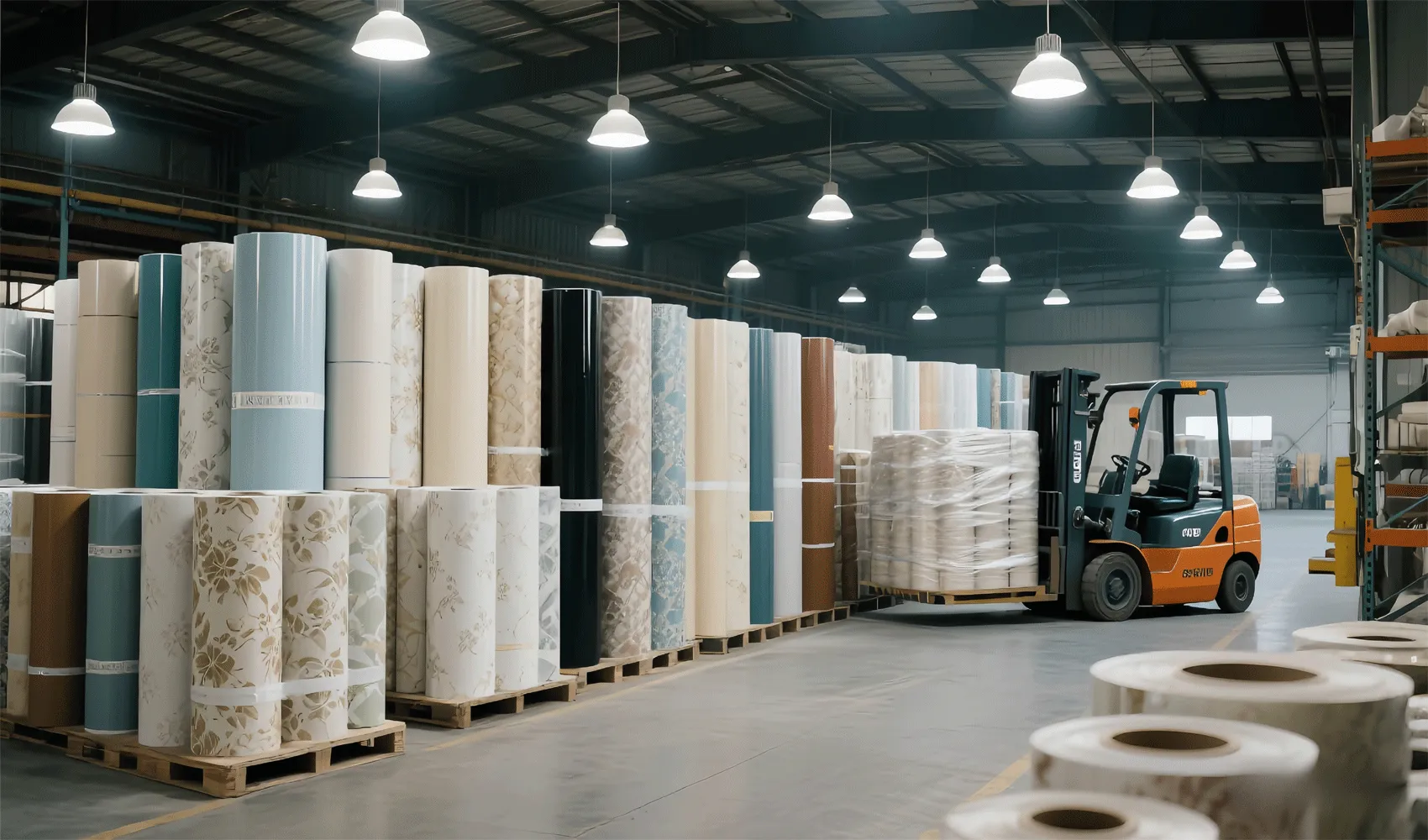
Calculating the weight of PVC film per square meter is quick and essential for purchasing, quoting, and production planning. This guide gives you a simple formula, worked examples, a ready table for common thicknesses, and practical tips you can use right away.
Manufacturers, distributors, and end-users rely on weight per square meter (g/m²) to estimate shipping costs, material yield, and product durability. For contractors and DIYers, it helps match the right film thickness to an application without guesswork.
Weight (g/m²) = Density (g/cm³) × Thickness (µm)
Notes: If thickness is in millimeters, multiply thickness (mm) by 1000 first: Weight (g/m²) = Density (g/cm³) × Thickness (mm) × 1000. This simple multiplication works because 1 µm × 1 g/cm³ = 1 g/m².
Example 1 — Flexible PVC film: density ≈ 1.20 g/cm³, thickness = 100 µm → weight = 1.20 × 100 = 120 g/m².
Example 2 — Standard PVC film: density ≈ 1.37 g/cm³, thickness = 200 µm → weight = 1.37 × 200 = 274 g/m².
| Thickness (µm) | Density 1.20 g/cm³ | Density 1.37 g/cm³ | Density 1.45 g/cm³ |
|---|---|---|---|
| 50 | 60.0 | 68.5 | 72.5 |
| 80 | 96.0 | 109.6 | 116.0 |
| 100 | 120.0 | 137.0 | 145.0 |
| 150 | 180.0 | 205.5 | 217.5 |
| 200 | 240.0 | 274.0 | 290.0 |
If you order film by weight, use these calculations to confirm quantities and avoid shortfalls. If you order by area (m²), convert area × g/m² to understand transport weight and pallet loads. For packaging or laminating lines, accurate g/m² lets you estimate glue consumption and press settings.
Pulivk (Henan Pulivk New Materials Co., Ltd.) offers customizable PVC film thicknesses and can provide exact density values for specific formulations to help you calculate precise g/m² for your orders.
1. Verify material density with your supplier—plasticized vs. rigid PVC changes density.
2. For multi-layer films, calculate each layer’s g/m² and sum them to get the total weight per m².
3. Allow a small tolerance (±2–5%) when quoting or packaging to cover processing variation.
Q: What density should I use if unknown? A: Use 1.20 g/cm³ for highly plasticized flexible PVC and 1.37 g/cm³ as a safe average for common decorative films.
Q: Does additives or coatings change the result? A: Yes—fillers and coatings alter density. Recalculate with the supplier’s density for best accuracy.