Address
304 North Cardinal St.
Dorchester Center, MA 02124
Work Hours
Monday to Friday: 7AM - 7PM
Weekend: 10AM - 5PM
Address
304 North Cardinal St.
Dorchester Center, MA 02124
Work Hours
Monday to Friday: 7AM - 7PM
Weekend: 10AM - 5PM


Understanding PVC film tensile strength is essential for manufacturers, specifiers, and quality teams who rely on consistent performance for packaging, decorative surfaces, and protective films. This guide explains the key performance indicators (KPIs), common testing methods, specimen preparation steps, and practical tips to ensure reliable tensile data for PVC film products.
When evaluating PVC film performance, labs and product teams focus on a few core KPIs: tensile strength at break, elongation at break, and Young’s modulus (tensile modulus). These metrics indicate durability, flexibility, and stiffness under load. For most commercial PVC films, it’s important to measure both machine direction (MD) and transverse direction (TD) because anisotropy from calendering or extrusion affects performance.
| PVC Film Type | Tensile Strength (MPa) | Elongation at Break (%) | Typical Use |
|---|---|---|---|
| Flexible calendered PVC | 20 – 35 MPa | 100 – 400% | Floor film, protective overlays |
| Rigid PVC film (thin sheet) | 35 – 55 MPa | 20 – 80% | Decorative panels, lamination |
| Multi-layer composite film | 25 – 45 MPa | 50 – 200% | Barrier / functional films |
Differences between MD and TD values reveal processing effects: higher MD strength often reflects polymer orientation during calendering, while TD values show cross-direction reinforcement. Specify both directions in product specifications to prevent field failures.
Use internationally recognized standards to generate comparable and repeatable results. The most commonly used test methods for thin polymer films include ASTM D882 and ISO 527-3. Both describe sample preparation, test speeds, gauge length, and reporting conventions.
Cut specimens from representative film areas (MD and TD). Typical specimen width is 25 mm or as required by the chosen standard. Measure film thickness at multiple points using a calibrated micrometer. Condition samples at 23 ± 2°C and 50 ± 5% relative humidity (or per customer requirement) for at least 24 hours before testing.
Use an Instron or equivalent tensile tester with pneumatic or serrated grips to avoid slippage. Recommended test speeds range from 50 mm/min to 500 mm/min depending on film thickness and the standard used — 50 mm/min is common for flexible films under ASTM D882. Record crosshead speed, gauge length, and grip separation in test reports.
Key outputs include tensile strength at break (maximum stress), elongation at break (strain at failure), and stress–strain curve shape. A high elongation with moderate tensile strength signals ductility and impact resistance; a steep initial slope indicates higher modulus and stiffness.
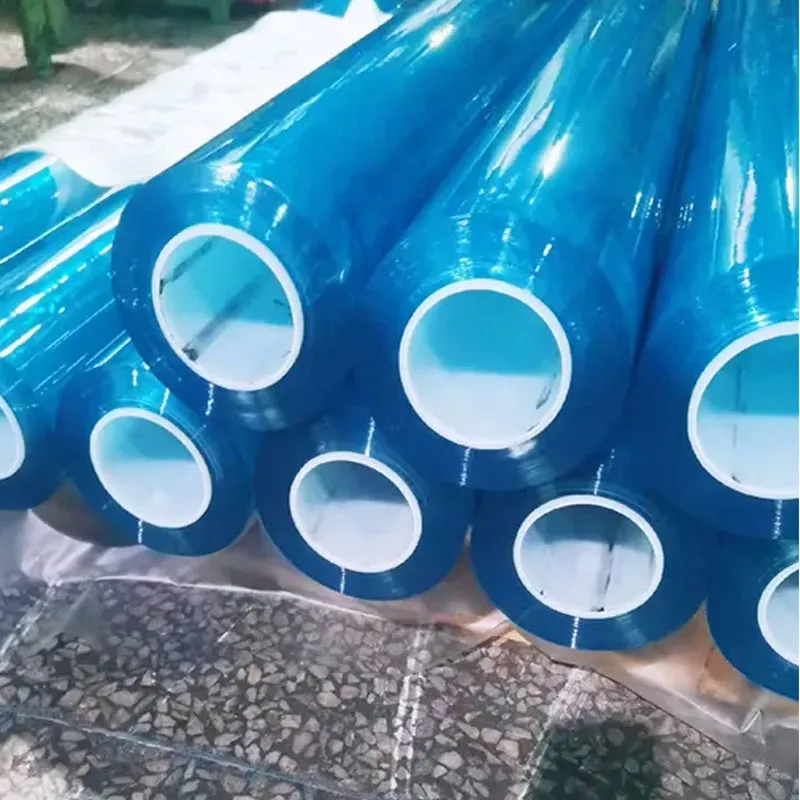
Improve tensile properties by adjusting formulation, processing, and film structure: optimize plasticizer type and content, increase molecular weight or use impact modifiers for toughness, refine calendering roll gap and cooling to control orientation, or adopt multi-layer constructions for targeted strength.
Ensure consistent tensile data by monitoring raw material lot variability, measuring thickness across rolls, performing regular machine calibration, and using control charts for KPIs. Record MD/TD results and track long-term trends to detect subtle process drift.
Avoid gripping damage, inconsistent thickness, incorrect humidity conditioning, and failing to test both directions. Slippage or notching at the clamp can lead to underestimated strength; use appropriate grips and clamp faces for thin PVC films.
A clear test report should include: standard invoked (ASTM/ISO), specimen orientation, thickness (average and range), conditioning details, crosshead speed, test machine model, raw stress–strain data, and calculated KPIs. This transparency supports robust quality claims and facilitates supplier comparisons.
For reliable PVC film supply and testing support, Pulivk offers full in-house production capabilities, including calendering lines and QC checkpoints—contact via https://pvcfilmtec.com/ for technical enquiries and custom specifications.