Address
304 North Cardinal St.
Dorchester Center, MA 02124
Work Hours
Monday to Friday: 7AM - 7PM
Weekend: 10AM - 5PM
Address
304 North Cardinal St.
Dorchester Center, MA 02124
Work Hours
Monday to Friday: 7AM - 7PM
Weekend: 10AM - 5PM


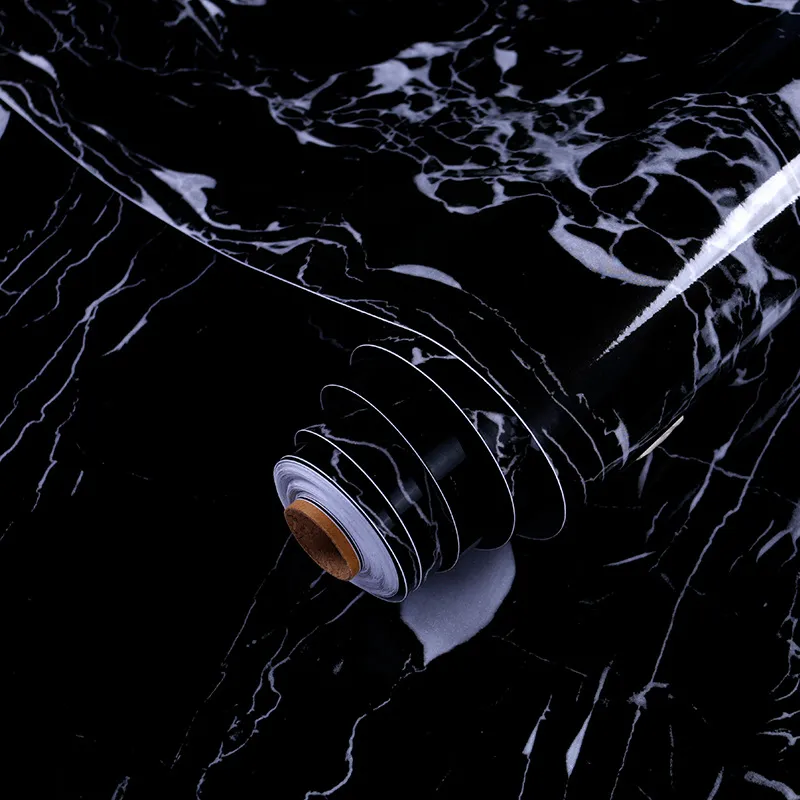
Metallic PVC film is a decorative and functional surface material designed to deliver a premium “metal” appearance while keeping the processing advantages of PVC: flexibility, stable thickness, easy lamination, and scalable manufacturing. It is widely used for furniture panels, cabinet doors, interior wall cladding, shopfitting, appliances, elevator interiors, exhibition backdrops, and many other surfaces where a modern reflective look is desired without the cost and weight of real metal sheets.
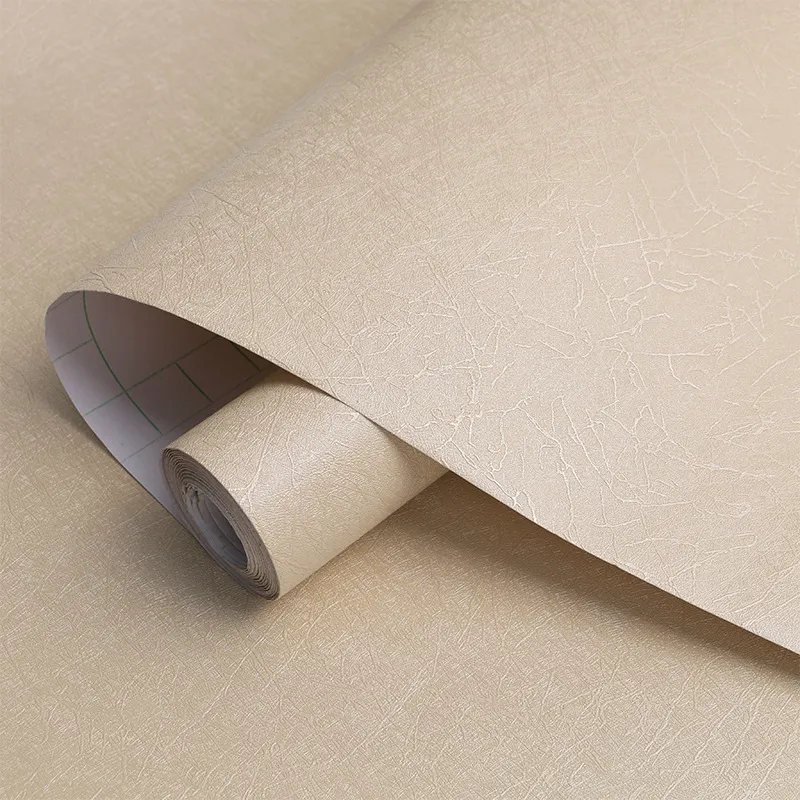
In this guide, you’ll learn how metallic PVC film works, where it performs best, how to read key specifications, and how to select the right type for your project—whether you need a mirror-like gloss, brushed texture, embossed patterns, or special performance such as anti-static or easy-clean coatings.
Key takeaway:
The “right” metallic PVC film is not just about shine. It’s a match between surface effect, substrate, application method, and environment (heat, humidity, abrasion, chemicals, UV).
Metallic PVC film is a PVC-based decorative film engineered to mimic metal finishes such as aluminum, stainless steel, chrome, and brushed metal. The metallic effect can be created by printed metallic pigments, metallized layers, or optical surface structures (e.g., hairline/brushed patterns, micro-embossing). Depending on the design, metallic PVC film can range from subtle satin shimmer to high-gloss, mirror-like reflections.
Most metallic PVC films are produced as calendered films (stable thickness, good flatness, consistent roll quality) and can be laminated onto MDF, plywood, particle board, metal panels, or composite boards. If you need a stable base film for lamination or printing, you can review calendered options here:
https://pvcfilmtec.com/product/calendered-film/.
Metallic finishes elevate cabinet doors, wardrobe panels, drawer fronts, and display furniture. Brushed or hairline textures hide fingerprints better than mirror gloss, making them popular for kitchens, retail counters, and office storage.
Metallic PVC film is used for feature walls, partitions, column wraps, and trims in commercial interiors. For matching edges and interior skirting applications, product formats similar to skirting film are often selected:
https://pvcfilmtec.com/product/pvc-skirting-film/.
For appliance panels and electronic housings, metallic PVC film offers a clean, modern look with optional functional treatments such as anti-static, scratch resistance, or easy-clean topcoats. Selection here depends heavily on abrasion performance, adhesive compatibility, and thermal exposure during forming/lamination.
Metallic effects are eye-catching under spotlights and are often used for exhibition counters, POP displays, brand walls, and temporary installations. For tactile, premium textures (silk-like, embossed) paired with visual depth, specialty texture films can be relevant:
https://pvcfilmtec.com/product/3d-silk-texture-film/.
✔ Lightweight & cost-effective:
Achieve metal aesthetics without heavy sheets, complex fabrication, or high raw material cost.
✔ Fast processing:
Suitable for lamination, wrapping, and many panel production lines; supports high-volume output.
✔ Design versatility:
Choose gloss, matte, satin, brushed, embossed, geometric patterns, and custom colors.
✔ Practical surface performance:
With the right topcoat, films can resist stains, scratches, and cleaning chemicals in daily use.
✔ Consistent appearance across batches:
Industrial film production supports stable color, thickness, and surface effect when paired with proper QC.
Designed for premium, reflective surfaces (showroom fixtures, decorative wall panels). It highlights surface imperfections, so substrate flatness and clean lamination are critical. Consider anti-fingerprint or easy-clean topcoats if used in touch-heavy areas.
A more “industrial” look that hides minor scratches and fingerprints better than mirror gloss. Popular for cabinets, office furniture, elevator interiors, and modern retail.
Embossing adds depth, improves scratch camouflage, and increases perceived value. It’s also a practical option for large surfaces because texture reduces glare and visually evens out substrate variation.
A quick solution for renovation, signage, and wrapping applications. Performance depends on adhesive type (initial tack, long-term holding power, removability) and the surface energy/cleanliness of the substrate.
Thickness influences durability, emboss depth, and handling during lamination. Thicker films can feel more premium and tolerate forming/wrapping better, but must match equipment capability and cost targets.
Choose widths that minimize waste on your panel size. Confirm roll length for production planning and core diameter for machine compatibility. For export logistics, ensure protective wrapping and clear labeling for traceability.
Metallic film appearance can shift under different lighting (warm vs cool LEDs) and viewing angles. Request samples and evaluate in the real installation environment. For mass production, check batch consistency and define acceptable tolerances for gloss and color.
For kitchens and commercial spaces, prioritize stain resistance and cleaning chemical resistance. For sunlit areas, ask about UV stability and yellowing risk. For hot environments (near ovens, equipment), verify heat resistance and dimensional stability.
Your process might be flat lamination, membrane pressing, profile wrapping, or self-adhesive installation. Confirm the recommended adhesive system, press temperature/time, and whether the film is designed for vacuum/membrane forming. A great metallic effect can fail if the adhesive and substrate are mismatched.
Identify whether the film will go on flat panels (easier) or profiles/edges (requires better flexibility and edge conformability). Also confirm the substrate type (MDF, plywood, metal, plastic) and surface preparation requirements.
For high-touch areas (kitchens, retail counters), brushed/satin finishes typically look cleaner over time. For decorative walls or display zones, high gloss may deliver maximum impact.
If the surface will be cleaned frequently (commercial interiors, kitchens), ask for a coating designed for repeated wiping and common detergents. For kitchen-specific protection concepts (oil-proof / anti-oil surfaces), related film solutions can be reviewed here:
https://pvcfilmtec.com/product/kitchen-anti-oil-film/.
Many buyers require documentation for safety and sustainability. Common references include REACH, RoHS, and management systems such as ISO 9001 / ISO 14001. If the film will be used in sensitive environments, verify that inks and additives are appropriate for indoor use and human contact.
Always test: adhesion, edge wrapping (if needed), resistance to scratches and cleaners, and visual consistency under your actual lighting. For production planning, confirm MOQ, lead time, packaging, and batch traceability before scaling up.
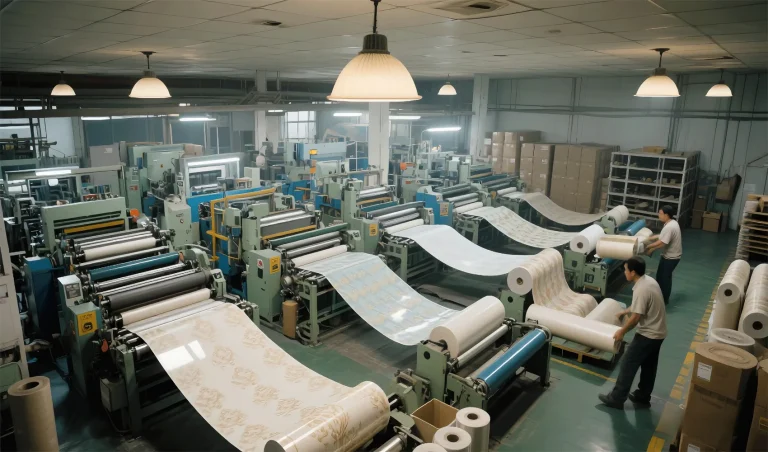
Reliable metallic PVC film supply depends on stable production, consistent raw materials, and process control. A full-cycle manufacturer with calendering, printing, and slitting/packaging in-house can typically manage quality consistency and delivery schedules more effectively—especially when custom colors, embossing, or OEM packaging are involved.
Keep substrates flat, clean, dry, and dust-free. Metallic gloss surfaces show tiny bumps and trapped particles more than woodgrain or matte films.
Excessive web tension can create stretching marks, while insufficient heat/pressure can cause poor bonding. Follow the supplier’s lamination parameters and run a short trial to lock in settings.
Store rolls upright in a stable environment, away from direct sunlight and heat sources. Use protective wrapping until installation to reduce micro-scratches—especially for high-gloss metallic finishes.
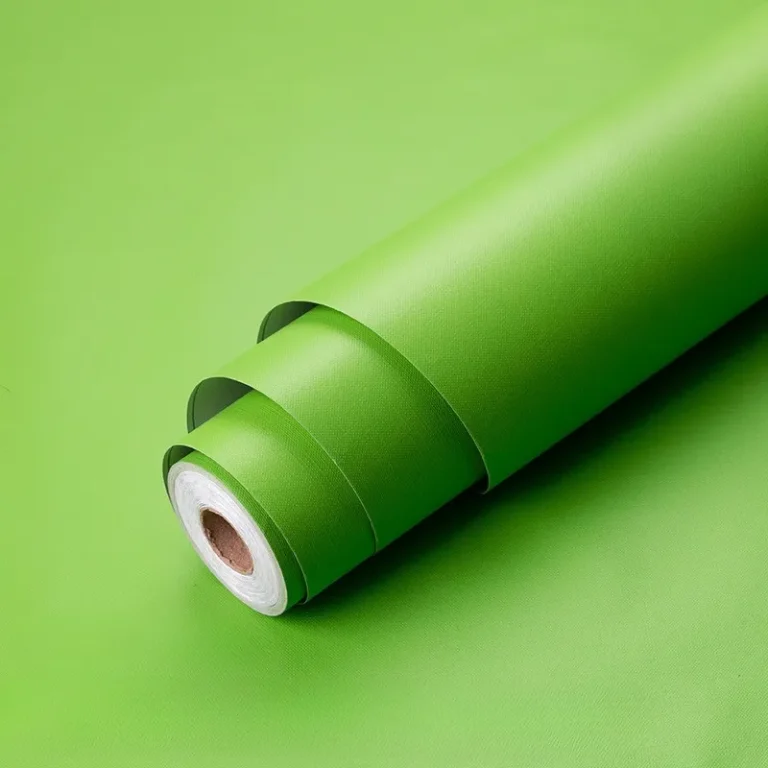
Many projects mix metallic accents with other decorative films to balance warmth and modernity—such as pairing brushed metallic cabinet trims with woodgrain door panels, or combining metallic wall features with solid-color backgrounds. If your design needs a coordinated, minimal look across large wall areas, solid-color decorative options are often used alongside metallic accents:
https://pvcfilmtec.com/product/solid-color-wallpaper/.
For brands managing multiple product lines (furniture, wall panels, trims, and flooring), working with a supplier capable of OEM/ODM customization—thickness, width, printing, embossing, and packaging—can simplify color matching and lead-time control across the whole program.
Yes—especially brushed or satin metallic finishes. For kitchens, prioritize easy-clean coatings, stain resistance, and adhesive/lamination compatibility with your cabinet substrate.
There is no universal “best” thickness. Choose based on your process (flat lamination vs wrapping), durability expectations, and cost. Always validate with samples and a small production trial.
High-gloss metallic surfaces show fingerprints more easily. Brushed/embossed textures hide marks better. For demanding environments, request anti-fingerprint and anti-scratch topcoat options.
Yes. Many manufacturers support OEM/ODM for thickness, width, surface texture, printing, and packaging—important for matching your brand’s design language across product lines.
Confirm visual consistency under real lighting, adhesion strength after curing, scratch/chemical resistance for the intended cleaning routine, and packaging/labeling for batch traceability.